Why elephants have long trunks?
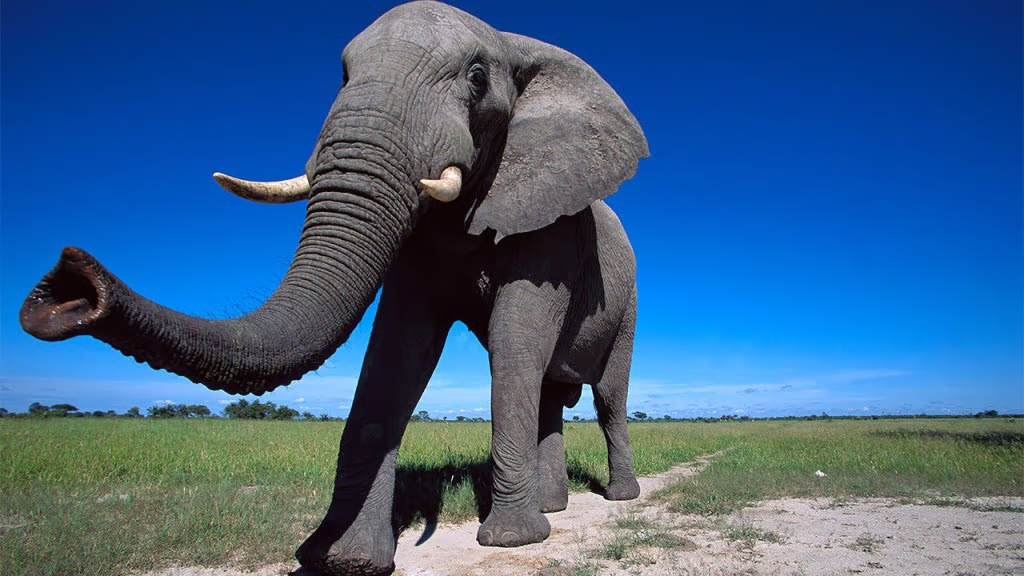
Their trunk is an extended nose fused with the top lip. At the end of their trunks are prehensile ‘fingers’ (prehensile meaning bring able ‘to grasp’) which it uses to curl around objects and pick them up. The African elephant has two ‘fingers’ whilst the Asian elephant only has one.
Trunks can grow up to 2 meters in length, and they can weigh 160 kg (353 pounds). Rings of cartilage support the two nostrils all along the trunk. The trunk does not have bones. Therefore, elephants can move their flexible trunk in whatever direction they need to.
The trunk alone contains about 40,000 muscles compared to humans 650. With all those muscles, the trunk can lift objects of 320 kg (772 pounds).
An elephant has a long trunk because it’s a highly versatile tool for survival, serving as an extension of their nose and upper lip for breathing, smelling, and drinking. This elongated, muscular appendage allows them to grasp food from high branches or low to the ground, and it’s crucial for a wide range of activities like communication, social interaction, and defense. Functions of the trunk:
– Feeding and drinking: Elephants use their trunks to suck up water and spray it into their mouths, as well as to grab and eat food like leaves, grass, and roots. They can lift food with great strength or pick up a delicate blade of grass with precision.
– Breathing and smelling: The trunk is an essential organ for breathing and has a highly developed sense of smell. Elephants have an incredible sense of smell, able to detect food that is several miles away. Their nostrils are located at the tip of their trunk and contain more smell receptors than any other mammal – including dogs
– Manipulation and touch: It acts as a flexible hand, used for touching, feeling objects, and exploring their environment. They can use it to caress their young or to caress other elephants.
– Communication: Elephants use their trunks to make sounds like trumpeting and to touch each other as part of their social behavior.
– Defense: The trunk can be used to defend themselves or to protect their young by guiding or lifting them.
– Other uses: They can also use their trunks as snorkels when swimming or to dust themselves for protection and comfort.
– An elephant has a long trunk because it’s a highly versatile tool for survival, serving as an extension of their nose and upper lip for breathing, smelling, and drinking. This elongated, muscular appendage allows them to grasp food from high branches or low to the ground, and it’s crucial for a wide range of activities like communication.